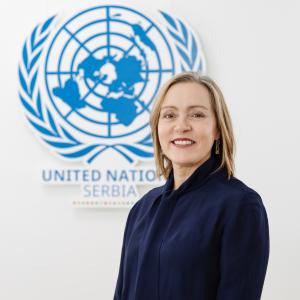
Keynote Address by Matilde Mordt, UN Resident Coordinator in Serbia - IPU Global Conference of Women Parliamentarians Advancing parity: Breaking the barriers of gender stereotypes - Session 6
At the IPU conference in Belgrade, UN Resident Coordinator Matilde Mordt spoke on leadership, institutional reform and breaking gender stereotypes in politics.
Excellencies,
Dear colleagues,
Ladies and gentlemen,
Thank you to IPU and Serbia for organizing this important and timely conference.
It is a pleasure to join this discussion on leadership and culture change to break gender stereotypes.
Gender equality, as we all know, does not happen by default. It happens because societies and institutions make deliberate political and structural choices.
For instance, in the political realm:
Across the world, countries have introduced different mechanisms to support women’s political participation and representation — from quotas and parity laws to institutional reforms and accountability measures. In many countries, including Serbia, results have been positive.
And yet, women still hold only around 27 per cent of parliamentary seats globally.
So while progress is possible, it remains uneven.
Part of the reason is that stereotypes are not only social; they are institutional. They shape who is encouraged to lead, whose expertise is trusted, and whose authority is accepted.
This is where leadership becomes critical.
And here, I want to share a historical note from the United Nations. The first General Assembly of the UN was held in London in January 1946 – 80 years ago. Of the around 300 delegates, only 17 were women, a reflection of the deeply male dominated diplomatic environment of the time. These women started to meet and exchange across diplomatic lines, facilitated by Eleanor Rooselvelt, who in February of that year presented an “Open Letter to the Women of the World” to the General Assembly. The letter called for women to take a more active role in international affairs; national governments; and peace, reconstruction and post war recovery. One can say that this advocacy had immediate effect. That same month, the UN created a sub commission on the Status of Women within the Commission on Human Rights, and only four months later, this became a Commission on its own, reporting directly to ECOSOC.
In sum: the issue of women’s status was a permanent institutional feature from the very beginning of the United Nations. The UN has helped move gender equality to the center of the global agenda — from the UN Charter in 1945, to the Convention on the Elimination of All Forms of Discrimination against Women (CEDAW) in 1979, to the Beijing Platform for Action in 1995, to the Sustainable Development Goals in 2015. And of course, there has been numerous deliberations in between these important milestones.
This is on the side of the Member States and global agreements. We have another UN, which is the UN of the content of the work: in peacekeeping, human rights, humanitarian action, and development, with an immense portfolio of programmatic activities of Agencies, Funds and Programmes – which we will hear more about in the panel, from my colleagues from UNESCO and UNHCR.
I want to focus now on how the UN applies these principles internally, in management and organizational structures.
Within UN, there has also been progress. This progress has not happened organically - It has required sustained institutional reform: changes in how we recruit; parity targets; accountability mechanisms; mandatory trainings; parental leave and breastfeeding policies; and measures to prevent sexual exploitation, abuse and harassment. Speaking as a manager, which I have been over several decades within different entities, I can testify to the changes over time and to the strong policies that are in place, as well as the commitment of staff and managers. I am truly proud of the UN in this respect.
And the results are there - let me give you a few examples: We have a UN System-wide Gender Parity Strategy, that provides overall guidance. Today, parity at the most senior leadership levels across the UN system is close to being achieved. And on the ground, today, women represent 55% of UN Resident Coordinators globally (55% of a total of 130 RCs, covering 162 countries and territories). That is commitment translated into concrete results.
One lesson stands out very clearly from the UN’s experience:
Culture change is slow. It requires leadership that is intentional, consistent, and willing to challenge long-standing assumptions about authority, credibility and power.
So, policies and targets create the framework, and leadership determines whether inclusion becomes part of institutional culture.
And we should remain honest about the work that still lies ahead.
The United Nations has never had a woman Secretary-General, a reminder that even institutions strongly committed to equality continue to reflect broader structural barriers that persist across societies and sectors.
This year, as the election of a new SG is ongoing, the world has a historic opportunity to choose a woman to lead the organization. For now, there are five candidates, of which three are women – we will see what member states will decide.
What we know is that inclusive institutions are not only fairer — they are stronger, more credible, and better equipped to respond to increasingly complex and polarized societies.
Thank you.



Govor održao/la
Ciljevi koje podržavamo kroz ovu inicijativu