
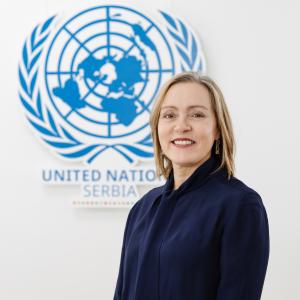
United Nations at 80 – Diplomatic event at Museum of Yugoslavia Speech by UN Resident Coordinator Matilde Mordt
Marking 80 years of the UN, Serbia and the UN gathered at the Museum of Yugoslavia to celebrate lasting partnership and results improving people’s lives.
Dear Ambassador Katarina Lalic Smajevic, Assistant Minister for Multilateral Cooperation
Dear Dominika Krois, Head of the United Nations’ Office in Belgrade and Secretary Generals Representative in Serbia,
Ministers, government officials, Excellencies, colleagues, partners, and friends,
It is an honor to mark with you eighty years since the founding of the United Nations — here, in the Museum of Yugoslavia, a place filled with history and symbolism. I want to thank the Museum and the Government of Serbia for allowing us to hold this event here today.
Yugoslavia was one of the United Nations’ founding members — and its voice mattered. It stood for dialogue, solidarity, and cooperation among nations that were finding their way after the devastation of war. That spirit of openness and multilateral engagement continues today through Serbia’s partnership with the United Nations.
The United Nations Charter, signed in 1945, begins with the words “We the Peoples.” It sets out a vision of peace, dignity, and equality that still guides our work today — and it established a shared duty: to maintain peace and security, uphold human rights, foster social and economic progress, and provide help to those in need.
Over eight decades, the United Nations has helped shape the world we know.
As beautifully described in the book “United Nations ideas that changed the world” there is not one United Nations, but three:
-
the first — the Member States, who set the vision and make the decisions;
-
the second — the United Nations’ agencies and staff, who turn that vision into action;
-
and the third — civil society, academia, and the private sector, who contribute and influence the global conversations and inspire the United Nation to evolve.
Through collaboration between these three strands, the United Nations has been the platform for landmark achievements such as the Universal Declaration of Human Rights in 1948; the Beijing Declaration, a milestone for women’s rights and gender equality that this years is celebrating 30 years of existence; and the Agenda 2030 and the Paris Agreement that were adopted in 2015 – just to mention a few.
These collective agreements have been born out of decades of persistence and collective effort.
This interplay between ideas, policy, and people has kept the United Nations alive — a living ecosystem that continues to generate new ways of thinking about progress and human well-being.
The Sustainable Development Goals themselves emerged from the most participatory process in United Nations history — proof that when governments, experts, and citizens come together, they can imagine and agree on a shared future.
And beyond these visible milestones, the United Nations quietly shapes our everyday life — setting global standards in for example aviation, Information Technology and maritime transport, so that cooperation between countries can function safely and fairly.
These efforts are not to be thrown away, but to be strengthened — to ensure we deliver on what we once dared to agree upon.
Today, there is a debate on the need for reforms of the United Nations in various dimensions. The financial situation is also a matter of concern. But I want to take the opportunity of this UN Day to remember and highlight the immense achievements of the organization to date.
Throughout these eight decades, the impact of the United Nations has been remarkable:
-
Thanks to our collective efforts, smallpox was eradicated in 1980. Today, the organization supplies vaccines to 45 percent of the world’s children, saving three million lives each year.
-
The United Nations protects and assists over 130 million people displaced by war, famine, or persecution, and reaches 180 million people in need of humanitarian assistance.
-
It upholds human rights through eighty international treaties and conventions.
-
During the era of the Millennium Development Goals, extreme poverty in the developing world was reduced from nearly half of the population in 1990 to just 14 percent in 2015 — lifting more than a billion people out of poverty. Today, Agenda 2030 calls, not for reduction, but for elimination of poverty, and guides our work through the principle of Leaving No One Behind.
-
And in the environmental field, the Montreal Protocol is a shining example of collective impact, leading to a recovery of the ozone layer.
-
Today, the Paris Agreement has contributed to unparalleled investment opportunities in renewable energy and is proving instrumental to slowing global warming – albeit more firm action is required.
These are not abstract numbers. They are lives protected, opportunities created, and hope restored — every single day.
Here in Serbia, the United Nations story is deep and human. It is written in classrooms, in health centers, in local administrations, and in the lives of people who turned opportunities into change.
Together with the Government, local communities, civil society, and our international partners, we work for a Serbia that is inclusive, green, and resilient - where human rights are protected and no one is left behind.
Our programmes help young people develop skills for the future; support farmers and entrepreneurs to grow greener businesses; and strengthen institutions to deliver better services and social protection. We support local innovation — from energy-efficiency projects in small towns to digital tools that improve access to healthcare. And we help communities adapt to climate change, invest in cleaner air, and protect Serbia’s extraordinary natural heritage.
Across the country — from Novi Pazar to Svilajnac, from Niš to Kikinda — we see the United Nations’s impact in the faces of people who tell their stories with pride:
-
Roma health mediators ensuring care reaches everyone;
-
young women starting tech businesses;
-
refugees who found safety and are now contributing to their new communities;
This is what the United Nations in Serbia stands for — many partners, one shared purpose: to improve lives and expand possibilities.
None of this would be possible without the people behind it — United Nations staff across the world and here in Serbia. With professionalism, empathy, and determination, they turn principles into action and keep the spirit of the United Nations alive every day. Regrettably, in some cases they pay with their own lives for this service – the last two years have been the deadliest ever faced by our humanitarian personnel and our hearts go out to them and their families.
On this day, I want to thank the staff of Agencies, Funds and Programmes present here, for their dedication and hard work. A special thanks go to the organizing team for this event, and the activities that will follow this opening segment.
Ladies and gentlemen: As we mark these eighty years, we are reminded of something simple but essential: peace is not built only in institutions — it begins in the way we see one another. In a world that too easily divides, tolerance, empathy and respect remain our strongest tools for building trust and preserving hope. That spirit of respect and dialogue is what keeps our mission alive.
That is what gives these eighty years their meaning.
I want to finalize with a quote that is close to my heart of former Secretary General Dag Hammarskjold. As a mountaineer myself, I found this view of our mission particularly inspiring:
“The qualities [that mountaineering] requires are just those which I feel that we all need today: perseverance and patience, a firm grip on realities, careful but imaginative planning, a clear awareness of the dangers but also of the fact that fate is what we make it and that the safest climber is he who never questions his abilities to overcome all difficulties”
Hvala puno


Govor održao/la
Ciljevi koje podržavamo kroz ovu inicijativu


