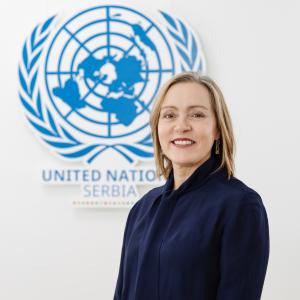
Speech by Matilde Mordt, UN Resident Coordinator in Serbia Launch of the UN–Serbia Cooperation Framework 2026–2030, 9th of February 2026
Remarks by UN Resident Coordinator Matilde Mordt at the launch of the UN–Serbia Cooperation Framework 2026–2030 in Belgrade.
Honorable Minister Marko Duric
Honorable Minster Nemanja Starovic
Dear partners from both Ministries present here, and particularly to the Sector for Multilateral Cooperation of MFA (Ambassador Katarina Lalic, Marina Ivanovic and Milica Alavanja, thank you for your support and bearing with us during the process of formulation and approval of the CF!)
Dear colleagues from Agencies, Funds and Programmes present here today – and those who are part of the team but on a non-resident basis. Thank you for your contribution for this important document. I also take the opportunity to thank all the staff at the Resident Coordinator’s Office that has been diligently supporting the drafting of the Cooperation Framework in both content and process.
-----------
It is a pleasure for me and the representatives of the United Nations Country Team in Serbia to be here today on the occasion of the signature ceremony of our Cooperation Framework 2026 to 2030. This act represents the shared commitment by the Government of Serbia and the United Nations on how to navigate the next five years together, in a time of profound global transitions.
Our joint goal remains achieving sustainable development, as expressed in Agenda 2030 and the Pact for the Future. Serbia has made significant progress in advancing the Sustainable Development Goals, in areas such as health, education and poverty reduction. It is a leader in digital transformation and has shown steady and resilient growth in the last decade. Serbia has a progressive constitution that enshrines fundamental freedoms, and its legislative framework is largely aligned with international norms and standards.
But Serbia is also facing challenges on several fronts: it is undergoing a rapid demographic transition. It encounters environmental challenges and increasing vulnerability to climate change, with implications for public health and the economy. Economic growth presents an opportunity to increase living standards, but efforts to address labor market gaps and boost productivity are still needed. And there is scope for promoting inclusive governance to improve accountability, expand civic space, advance human rights and gender equality.
In this context, what does the United Nations have to offer to support Serbia’s path towards sustainable development? What does the United Nations provide in a world in which multilateralism and cooperation between countries is being tested? Our firm belief is that the United Nations offers an invaluable collaboration:
- We bring in global normative standards to develop and improve legislative frameworks;
- We offer high-quality specialized technical expertise and support evidence-based policy making through unparalleled global knowledge networks;
- We share best practices and lessons from around the world;
- And we support capacity building for implementing integrated development solutions on the ground.
All this, to improve the lives of the population of Serbia. Leaving No One Behind is a principle of Agenda 2030 that guides us in everything we do.
During the previous Cooperation Framework cycle, from 2021 to 2025, we learned valuable lessons. We saw how much more effective our work became when institutions collaborated across sectors. We saw the impact of keeping the focus on those who are furthest behind. And we saw how policy reforms and innovation translated directly into better lives for people.
This new Framework builds on that experience, responding to where Serbia stands today.
It supports Serbia’s transition towards a greener and more resilient economy, invests in people through stronger health, education and social protection systems, and reinforces institutions, the rule of law and civic trust as the foundations of a cohesive society.
In simple terms, this Framework is about sustainable growth, human well-being and strong institutions — increasingly enabled by digital solutions and better use of data.
A particularly important feature of this Framework is the clear alignment between Serbia’s progress towards the Sustainable Development Goals and its path towards European Union accession. These are not separate agendas but largely coincide in objectives. We have been asked to support the reforms that bring Serbia closer to EU standards, and we are and will continue to be a trusted partner in this process.
Excellencies, the United Nations is proud to support Serbia’s development goals.
And we are proud of how we work in this process – in partnership with ministries, local governments, civil society, academia, the private sector and development partners, coming together and contributing to a shared vision:
By 2030, we want to see a Serbia that is more prosperous, more inclusive and more resilient. A Serbia where economic progress goes hand in hand with environmental sustainability. A Serbia where demographic change is met with smart policies and strong services. And a Serbia where institutions enjoy trust and society is inclusive.
On behalf of the United Nations Country Team, I would like to thank the Government of the Republic of Serbia, and especially the Ministry of Foreign Affairs and the Ministry of European Integration, for the leadership and close cooperation in shaping this Framework.
We look forward to continuing this partnership in the years ahead.
Hvala vam puno.



Govor održao/la
Ciljevi koje podržavamo kroz ovu inicijativu