
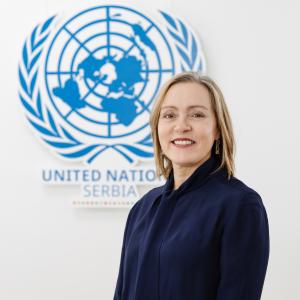
Belgrade Model United Nations - Speech by Matilde Mordt, UN Resident Coordinator in Serbia
Belgrade Model United Nations - Speech by Matilde Mordt, UN Resident Coordinator in Serbia
H.E. Ambassador Katarina Lalić Smajević, Assistant Minister for Multilateral Affairs, Ms.Ivana Antonijević, Assistant Minister for Tourism and Youth,
Mr. Stefan Kondic, Programme Director at UN Association of Serbia
Dear students, dear organizers, guests, colleagues from UN agencies:
A warm welcome to everyone: delegates, chairs, volunteers, and to all the partners that have helped convene this 23rd Belgrade International Model United Nations.
A special greeting and my sincere thanks to the United Nations Association of Serbia for convening this conference and for its long tradition of connecting Serbia to the ideals of the United Nations ever since it was first established in 1952. You are among the oldest civil society organizations in Serbia and of course a proud member of the World Federation of United Nations Associations.
Let me also thank our hosts for the opportunity to hold BIMUN in this historic Assembly building — a place long associated with parliamentary debate and democratic life. The word “parliament” itself comes from the French parler, meaning “to speak”. And I want to reflect on this basic capacity of humanity: to speak, to use words, to hold dialogue.
Words can feel small next to the scale of today’s crises, but in the public space, be it domestic or global, words are the first form of action. Words pre-empt violence, create understanding of the priorities and needs of our partners, and turn disagreement into shared agendas. That is the spirit of the United Nations: to bring people around the same table and to replace fear and mistrust with dialogue and a common sense of purpose. We need to return to the power of words.
The United Nations has, throughout its eight decades of existence, promoted agendas that has made humanity advance – in human rights, gender equality, human development, human security and so on. Today, the shared agenda of the United Nations, of all our Member States and of each of us, are the Sustainable Development Goals. And the SDGs too, were shaped by dialogue.
There are many aspects to Agenda 2030: how the concept of sustainable development evolved in time, the main challenges faced by humanity, the technicalities of the solutions to these challenges, and much more. Today, I want to focus on the process of how the Sustainable Development Goals came to be.
It was, in fact, the most participatory global conversation ever held! It was not only the 193 Member States that debated over several years and finally reached an agreement, but we also had youth groups, businesses, civil society and many other participating in these dialogues. We had input from experts and academia, several thematic consultations, and actually, the largest survey ever held globally, in which millions of people from all countries responded to questions about societies’ challenges, which topics felt most pressing, and what solutions to prioritize. If anyone says that this is an imposed agenda, they are wrong: this was the greatest collective dialogue ever on shared priorities for humanity’s survival.
In a world that is now so divided and full of uncertainty, it is easy to lose trust that dialogue, institutions, and cooperation can deliver. But BIMUN is a reminder that trust is not abstract, it is something we build: by actively listening to the position of our partners adversaries, by presenting our arguments convincingly around facts, and also by finding the courage to compromise.
Through the Model UN you experience firsthand why the United Nations remains indispensable—because it is built around dialogue and because it is still the only shared table where we can address challenges that no country can solve on their own: peaceful resolution of conflicts, the climate crisis, pandemics, the responsible use of new technologies, to name just a few.
Here in Serbia, as Ambassador Lalic pointed out, the United Nations has a longstanding cooperation. And we work with partners on challenges that matter for your generation — from climate action and environmental protection, to education, inclusion and opportunities for young people to participate and shape their communities.
You will also see that respecting common rules is the foundation of dialogue. And it is the same in larger settings as well. Respect for international law, including the UN Charter and international human rights law, the foundation of peace, security, and cooperation, and the best protection for smaller states and for people whose voices are too often ignored. As the Secretary General has expressed recently, the power of law needs to prevail over the law of power.
In the next days, you will be working on the theme of “Youth, Peace and Security”. I would like you to see this not as an abstract concept, but as your daily reality. We need a world where peace prevails, so you as young people can live your lives and your dreams.
I encourage you to take this simulation seriously: argue your positions with passion but treat each other with dignity; defend principles, but search for solutions; and remember that diplomacy is not about winning a debate, it is about protecting lives and seeking solutions.
If there is one message to open BIMUN, it is this: your generation is not only inheriting the world as it is, you are shaping the world as it will be. Believe in shared values, insist on cooperation over cynicism, and use your voice to strengthen multilateral solutions.
I wish you an inspiring conference.


Govor održao/la
Ciljevi koje podržavamo kroz ovu inicijativu


